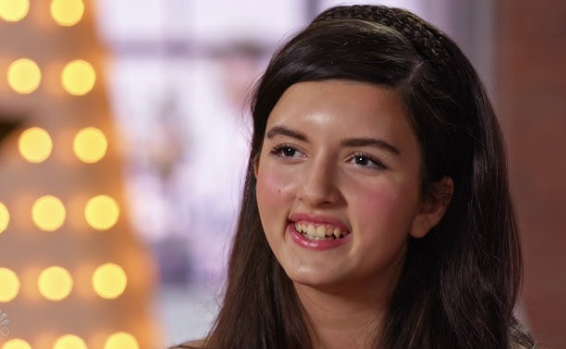
On January 6, 2020, the America’s Got Talent: The Champions stage welcomed a performance that many viewers still talk about: 14-year-old Angelina Jordan’s haunting, reinvented take on Queen’s “Bohemian Rhapsody.” By then, Angelina was already familiar to international audiences — she had won Norway’s Got Talent at age eight and built a reputation for singing with an old-soul sensibility far beyond her years. Still, her Champions appearance felt like a moment of arrival: she took a song that’s practically sacred in rock history and folded it into something wholly her own.
From the moment she stepped into the spotlight, there was a hush, the kind of anticipatory quiet that happens when an audience senses they’re about to witness something delicate and rare. Angelina didn’t come out with theatrics or pyrotechnics; she stood calmly, a modest figure in a simple dress, and let the music do the talking. Rather than attempting a straightforward rock rendition — which many would see as the safer, more obvious route — she reshaped “Bohemian Rhapsody” into a jazz-inflected, soulful ballad. It was a brave artistic choice: the song is known for its bombastic shifts, operatic sections, and Freddie Mercury’s iconic power. Angelina’s version traded his thunder for intimacy, turning bravado into vulnerability.
What marked the performance most was her voice. There was a maturity in her tone that seemed to belong to someone who had spent decades refining their craft rather than a teenager still in school. She delivered each phrase with an almost conversational expressiveness, bending notes with delicate vibrato, sliding into phrases as if telling a secret. At certain moments, she softened to a whisper, drawing listeners in, and at others she let sound swell, filling the hall with warmth. Those dynamics — the lightness and the swell — made familiar lines feel fresh; lines that we’ve heard a thousand times acquired new meaning when passed through her interpretation.
Small details amplified the emotional effect. Angelina’s phrasing often lingered on a single word or syllable, allowing a word to resonate longer than expected and giving the lyric room to breathe. Her timing was impeccable: she knew just when to hesitate for dramatic effect and when to release a note into the room. The arrangement itself was pared down, with gentle piano and understated percussion supporting her, so that the spotlight remained on her vocal storytelling. At one point, a single sustained chord underpinned a vulnerable line she sang, and you could almost feel the audience collectively leaning forward to catch every inflection.
The judges’ reactions were telling. Simon Cowell, known for his blunt critiques, spoke about Angelina’s artistic maturity and vision, noting that few singers her age could reach the emotional depth she displayed. It wasn’t flattery for its own sake; his praise felt like genuine recognition of something uncommon. Other judges echoed similar sentiments: admiration for her technique, but more importantly, awe at how she connected with the song’s emotional core. The applause that followed was not the raucous cheering typical of triumphant pop numbers but a sustained, reverent standing ovation — people rising not merely to applaud, but to honor the performance they had just witnessed.
What made Angelina’s rendition especially memorable was its fragility. There’s a tendency in talent shows to go big, to fill the room with volume and spectacle. Angelina proved the opposite: that power can reside in restraint. She allowed the song’s sorrow to surface without theatrics, which made the catharsis at the end feel earned. You could see the emotional shift in the room: skeptics softened, longtime Queen fans found themselves reconsidering a masterpiece through a new lens, and younger viewers discovered the capacity of a voice to reinterpret and reframe a classic.
Beyond the performance itself, Angelina’s history added resonance. She had already been praised for singing with the nuance of a jazz singer from another era, and this appearance reinforced that persona. Winning Norway’s Got Talent at eight had given her a platform, but moments like the Champions performance demonstrated growth — an artist choosing to take risks and trusting her instincts. Her version of “Bohemian Rhapsody” felt less like a cover and more like a personal conversation with the song, a reinterpretation shaped by her sensibilities.
Although ventriloquist Darcy Lynn ultimately took the top prize on America’s Got Talent: The Champions, Angelina Jordan’s performance remains one of the show’s most discussed highlights. It underscored her adaptability — the ability to cross genres and make each one feel authentic — and solidified her reputation as one of the most remarkable young vocalists of her generation. In a world that often prizes youth for its novelty, Angelina reminded audiences that youth can also bring profound depth, and that a courageous artistic choice can turn a familiar anthem into a luminous, unforgettable experience.