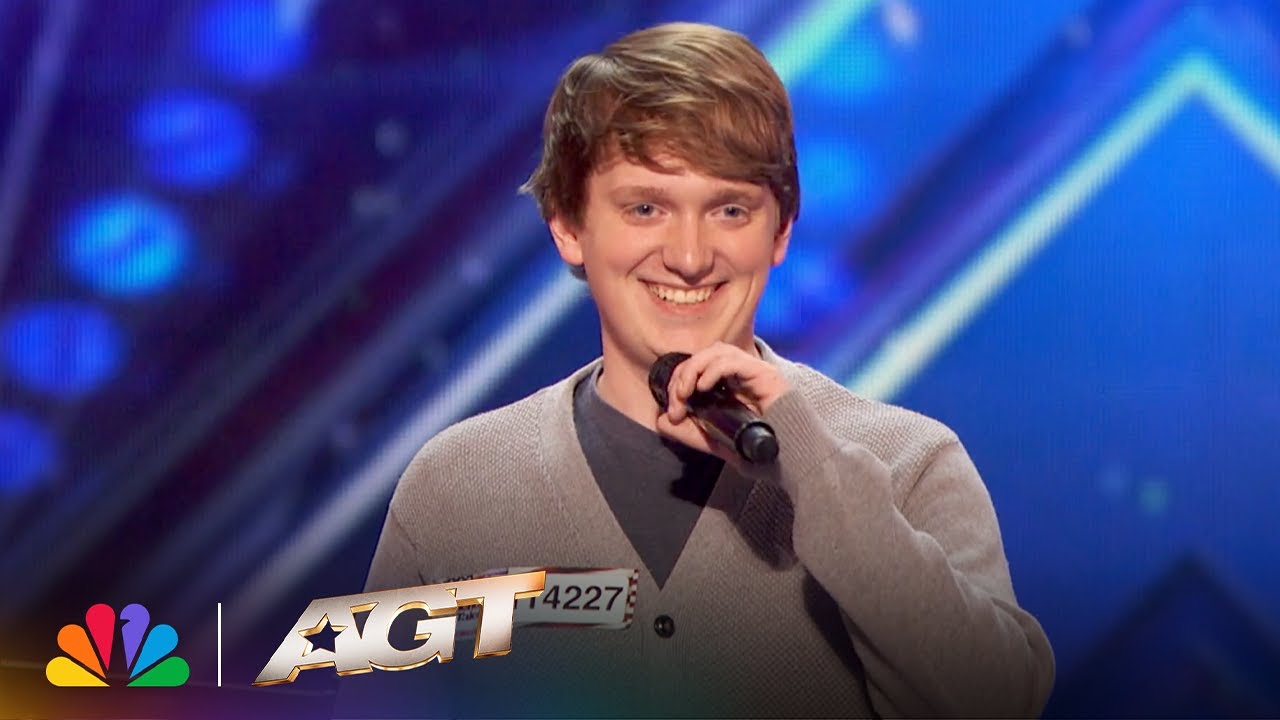
When 18-year-old Ryan Beard walked onto the America’s Got Talent stage, he didn’t look like he was about to melt hearts. He shuffled, glanced at his feet, flashed an awkward grin, and introduced himself in a voice that confessed more nervousness than swagger. He told the audience he was homeschooled, winked and joked that this obviously explained why “the ladies love him,” and the room chuckled politely. It was the kind of self-deprecating line that could have been a throwaway, but there was something in the way he said it that hinted there might be more than just a nervous kid and a rehearsed quip.
Then he sat at the piano.
What followed surprised nearly everyone. Rather than launching into a dramatic ballad or a power pop cover, Ryan began an original comedy song that unpacked the very joke he’d just told: a mock-epic ode to being a “ladies’ man” who, in reality, gets no attention from girls. The lyrics were clever in a way that felt effortless — small, observational details that made the premise believable and instantly relatable. He sang about awkward encounters, missed signals, and the kinds of tiny humiliations that hurt more because they’re so human: getting friend-zoned at a study group, waving at someone who didn’t see you, rehearsing the perfect line in the mirror only to lose it in real life.
His timing was impeccable. A well-placed pause, a slightly crooked musical flourish, and a face that transformed from earnest to exaggerated disbelief had the audience laughing before they even realized they were fully invested. He didn’t rely on crude gags or shock value; his humor lived in the specificity of the lines and the way he delivered them. A mention of his “romantic playlist” consisting mostly of classical practice tracks drew one kind of laugh; the visual of him conducting his own imaginary orchestra to woo someone drew another. Each punchline landed like a little reveal, making the next one hit harder.
The song showcased not just a knack for comedy but also real musicality. Ryan’s piano playing moved between sympathetic accompaniment and small, expressive runs that punctuated the jokes. He wasn’t just playing to support the punchlines — he was using the instrument as a storytelling tool, tying chords to emotional beats and accenting a phrase with a sly arpeggio. When he hit a particularly ridiculous lyric about being ghosted after “two months of postal correspondence” — a line as absurd as it was specific — the crowd roared. You could see the judges visibly leaning in, smiling in ways that said they were genuinely impressed rather than merely entertained.
What made the moment shine, though, was the way Ryan owned the self-deprecation. There’s a fine line between laughing with an audience and pleading for their pity; he walked it with perfect balance. His expressions were goofy and full of charm, never mean-spirited. He mocked himself and the situations without asking anyone else to. That confidence — the kind that lets you expose your own embarrassing moments and make them feel universal — is rare, especially on a stage where competitors often try to manufacture sympathy or amp-up drama.
As the song built to its final, delightfully melodramatic chorus, the energy in the room shifted from amusement to full-throated delight. Laughter turned into cheers, and a few people were clapping along purely on impulse. The judges, who can sometimes appear stony-faced even when they’re enjoying a performance, were laughing out loud. One leaned forward, wiping a theatrical tear of mirth from the corner of his eye; another covered her mouth, grinning like someone who hadn’t expected to be caught off guard by something so clever. When the last chord rang and Ryan gave a little bow that was more bashful shrug than showy flourish, the applause was immediate and enthusiastic.
The decision was as clear as the reaction. Four easy “Yes” votes landed on his name, and with them came the tangible sense of a fanbase being born in real time. Social feeds filled within minutes with clips and captions: “You have to see this kid,” “Best original comedy song of the night,” “Homeschooled and hilarious!” Comments praised not just the jokes but the songwriting and stagecraft — people noted details like the way he’d modulated the melody to underline a punchline or the little harmonic twist that made a throwaway line land musically as well as comedically.
In a season full of soaring voices, tragic backstories, and hyper-produced acts, Ryan’s set felt refreshingly honest. He reminded viewers that you don’t always need grand theatrics or heartbreak to be memorable; sometimes a piano, a clever song, and the bravery to make fun of yourself are enough to steal the show. Watching him walk off stage with a grin that matched the one he’d come on with — only a little more relieved and a lot more proud — you could tell he’d achieved something more than a passing laugh. He’d connected. And in a competition built on moments, that connection is often the thing that lasts.