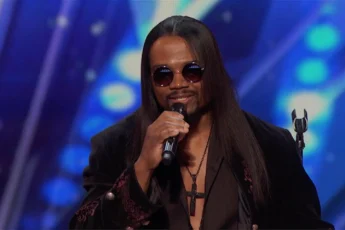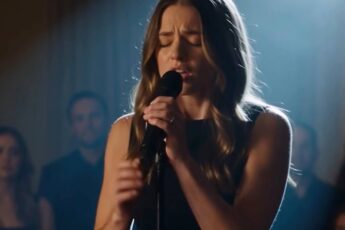

Sometimes the most powerful performances come from the most unexpected places. That truth was on full display when Robbie Kennedy — a young bricklayer with rough hands and a calm, unassuming manner — stepped onto the Britain’s Got Talent stage with just an acoustic guitar slung over his shoulder. He didn’t have a flashy outfit, dancers, or a glossy intro. He had a worn guitar, a simple stool, and a look that said he was there to do what he loved, not to court spectacle. For many people in the crowd, that quiet confidence suggested a modest, competent audition. No one was prepared for what happened when he began to play.
The first chord of “Iris” by the Goo Goo Dolls rang out and settled in the room like a soft, familiar memory. From that point on, everything shifted. There was an immediacy to the sound — raw and unvarnished — that felt like someone opening a window and letting in fresh air. Robbie’s voice had a kind of weathered warmth, not perfectly polished but wholly believable. It carried a gravelly edge that made each syllable feel lived-in; you could hear life in the timbre, as if every note had a story behind it. The audience responded instinctively: chatter faded, heads tipped forward, and the theater contracted into a single attentive body.
Robbie didn’t try to overwhelm the song with vocal gymnastics or dramatic flourishes. Instead, he honored the melody with restraint and emotional honesty. He strummed with a steady rhythm, fingers moving with the familiarity of someone who had played through nights and weekends between shifts at a job that demanded physical labor. That steady guitar created a foundation for his voice to reach into the more vulnerable parts of the lyrics. The intimacy of the arrangement made it feel as if he were singing directly to one person in the room rather than a giant televised audience.
Small details made the performance feel lived-in and genuine. When he reached the chorus and let the word “Iris” float on a held note, his cheeks flushed slightly with the strain of expression, showing that he was pouring himself into the moment. Occasionally he glanced down at his guitar, not to check technique but as if to commune with it — the instrument and the player working in quiet tandem. There was no microphone theatrics, no dramatic lighting changes; the stage remained simple, the lights warm, and the focus entirely on the song being delivered. Those choices underscored the core of what made the audition memorable: authenticity.
The judges’ reactions were immediate and telling. Where they usually sit with practiced curiosity, searching for marketability and unique angles, their faces softened into attentive, personal expressions. One judge, known for her sharp critiques, appeared moved — a hand to her mouth, eyes glossy. Another leaned forward, elbows on the table, as if he couldn’t believe the emotional clarity arriving from a man who had walked in quietly just minutes earlier. Their pens and scorecards felt less relevant; this wasn’t about ticking boxes. It was about bearing witness to an earnest human moment.
The audience’s energy followed suit. You could feel it rise and fall with Robbie’s phrasing. When he sang the lines that speak to longing and vulnerability, there was a collective stillness, the kind that suggests people are remembering something of their own. A few people wiped their eyes; someone in the back sniffed audibly. These aren’t dramatic gestures for show — they’re the natural responses of listeners touched by a performance that digs past surface skill into raw feeling. The applause at the end was long and heartfelt, the sort that grows organically because people want to express gratitude for being given a moment that mattered.
Perhaps what struck viewers most in the days after the audition wasn’t just the sound but the story implied in the performance. Here was a working-class young man who could have been anyone’s neighbor or colleague, standing under bright lights and revealing a talent that might otherwise have remained private. That juxtaposition — ordinary life meeting extraordinary art — is a powerful narrative in itself. It reminds us that creativity doesn’t need a polished background or privileged training to be profound. Often, life experience, grit, and the impulse to communicate are enough to produce something startlingly beautiful.
Robbie’s rendition of “Iris” served as a reminder that music can function as both confession and connection. For him, the song may have been a way to lay open an emotion that didn’t require explanation. For the listeners, it became a mirror, reflecting their own small regrets, longings, or moments of tenderness. Talent shows, at their best, offer a stage not just for performance but for human exchange. This audition encapsulated that possibility: a simple setup, a worn guitar, and a voice that carried the weight of personal truth.
When Robbie left the stage, applause still echoed in his ears and the faces in the crowd were turned toward him with a kind of affectionate respect. The moment lingered because it felt honest — a reminder that sometimes the most unforgettable performances are not the loudest or most ornate, but those where an ordinary person steps forward, gives everything they have, and in doing so, reveals an extraordinary gift.