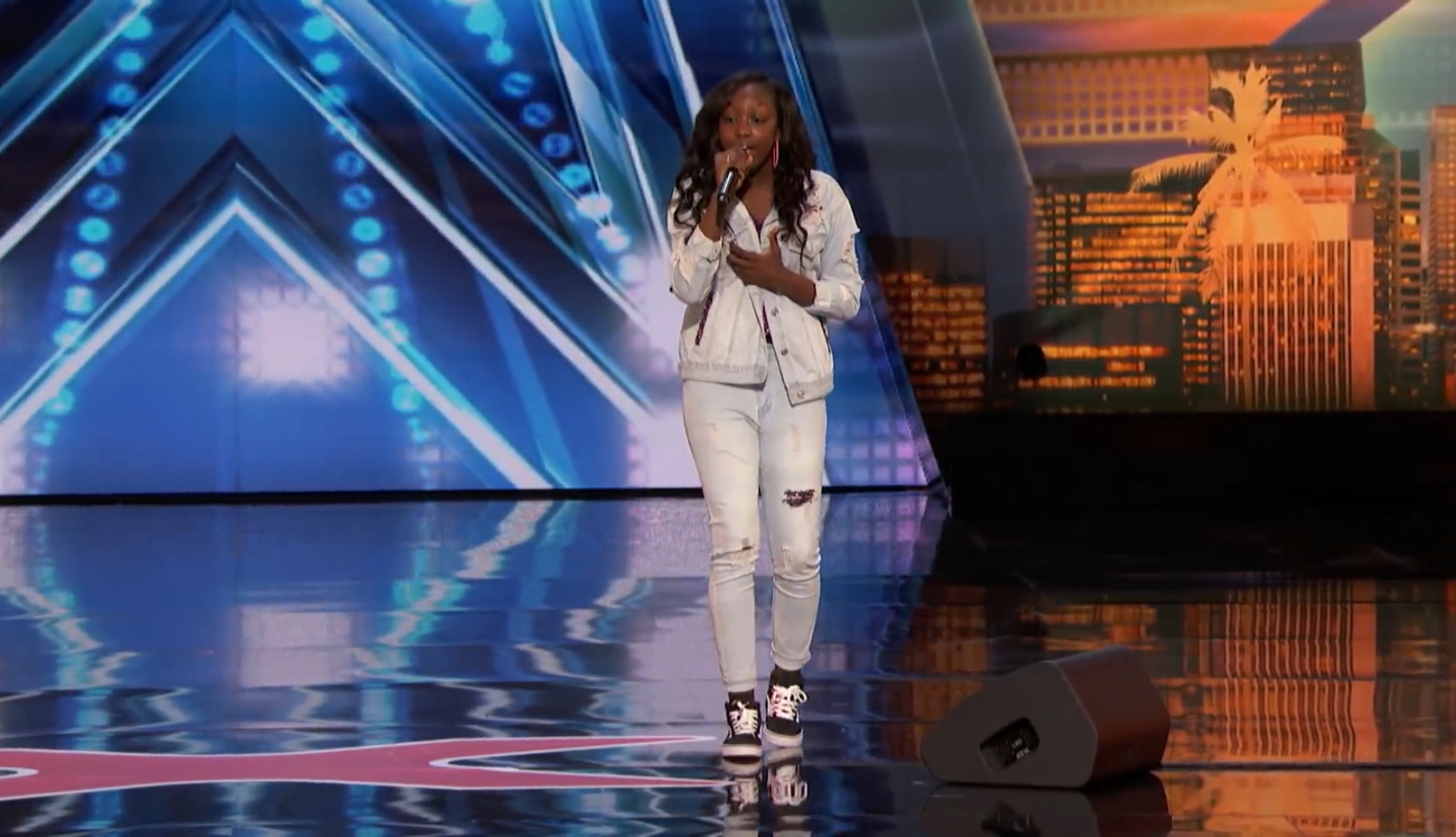
Flau’jae stepped onto the America’s Got Talent stage with a quiet intensity that suggested she had something important to say. At just fourteen, the Savannah, Georgia native carried a story that had shaped her life long before she learned how to write a full verse: her father, an aspiring rapper himself, had been killed before she was born. Rather than letting the absence define her in silence, Flau’jae channelled it into purpose. She didn’t come to AGT merely to compete; she came to pick up a mic for him, to continue the story he never got to finish, and to use music as a platform to confront the very violence that stole him away.
Before she even began, there was a palpable sense of gravity in the room. She explained, calmly and directly, why she had written an original song about gun violence and what it meant to her to perform it on a national stage. The choice to rap about such a raw, personal subject was brave — especially for someone so young — because it exposed a wound but also invited listeners into a collective reckoning. The theatre fell still in a way that suggested people were listening not just for technique, but for truth.
Then she launched into her track. From the first bar, Flau’jae’s flow was confident and precise. Her delivery was rapid-fire when it needed to be, pausing on certain lines to let the audience breathe in the weight of what she was saying. The chorus’s haunting refrain — the rhetorical, gutting question, “If you would have put that gun down, then he would have been here right now” — cut through the air with the simplicity and power of a universal truth. It was not just a lyric; it was an accusation, a memorial and a plea all at once. Her cadence shifted naturally between soulful introspection and staccato insistence, guiding the room through the emotional architecture of grief, anger and hope.
There were little moments within the performance that made it all the more striking. Flau’jae’s eyes registered the crowd’s reaction — a mixture of rapt attention and quiet tears — but she remained rooted to her message, never allowing the performance to become a spectacle. When she landed on a poignant line about legacy, you could feel the weight of several invisible generations in the room. The staging and beat were spare enough that her words took center stage; there was no overproduction to distract from the lyrics’ meaning. That restraint made the delivery feel more like a testimonial than a display, which in turn made it harder to look away.
What made the moment particularly memorable was how Flau’jae transformed private sorrow into a collective call to action. She refused to let her father’s story be merely a personal tragedy; she turned it into a question for her listeners: what are we willing to change to keep others from living the same fate? The line “put your guns down” resonated like a command to the audience, to policymakers, to communities — an insistence that the cycle of violence can be interrupted if people choose it. For a young artist, delivering such a mature, civic-minded message with clarity and conviction suggested an unusual combination of talent and moral clarity.
The judges’ reactions reflected the room’s intensity. Heidi Klum, visibly moved, praised Flau’jae for being “so on point and so honest,” capturing how the performance had cut past entertainment value to land as a real statement. Simon Cowell — not usually the first to speak in praise of rap, but always acute in identifying talent — offered perhaps the most consequential compliment. He admitted that while rap might not be his specialty, he could recognize greatness when he saw it, calling the audition his favorite by a clear mile and suggesting that this moment marked the beginning of a major career. For the panel, her mix of technical skill, vocal presence and uncompromising message made the decision inevitable.
When Flau’jae earned four enthusiastic “yeses,” the validation was about more than progression in the competition. It was an affirmation that her story belonged on a stage this large, that her voice could carry both art and advocacy forward. The judges’ unanimous support sent a clear signal: talent paired with purpose can move people in ways that transcend age.
As she left the stage, there was a sense that the moment would linger. Flau’jae hadn’t offered an abstract performance — she’d handed over a piece of herself and asked the audience to hold it with her. For viewers at home and for those in the auditorium, the audition felt like an introduction to an artist who intends to do more than entertain; she intends to wake people up. In the months and years that followed, that debut would likely be remembered not just for its technical bravado but for its courage: a teenager rapping about loss and calling, with unwavering clarity, for an end to the violence that had shaped her life.