
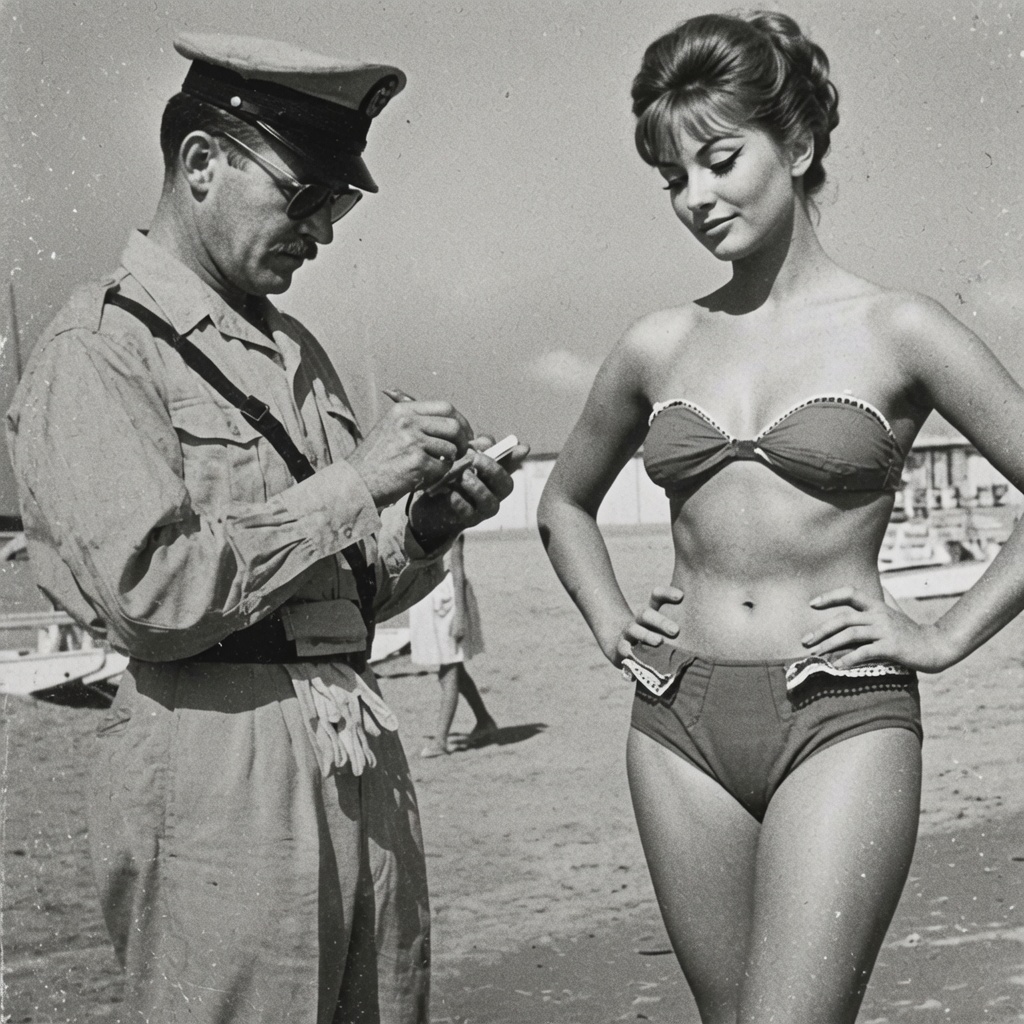
The photo looks harmless at first.
A young woman, maybe twenty-three, standing on the sand in a modest swimsuit. White gloves up to her elbows. A wide straw hat. A patient smile.
Behind her, a police officer in a dark uniform holds a small notebook.
For seventy years, people believed they knew the story. A ticket. A fine. Another sad chapter in the long war between women and beach modesty laws.
But the truth was buried much deeper than that.
Her name was Margaret “Maggie” Halloran. She was twenty-three years old, a schoolteacher from a quiet town on the Jersey shore. And in the summer of 1954, she walked onto Sunfield Beach wearing those long white gloves every single morning for eleven days in a row.
At first, nobody paid attention.
Then the whispers began.
“Why does she never take them off? Even in the water?”
“I heard she sleeps in them.”
“My cousin says she’s hiding something awful under there.”
The town gossip grew louder each afternoon. Some said she had a skin disease. Others claimed she was in mourning for a lost fiancé. A few older women insisted she was simply “putting on airs.”
Officer Daniel Prescott, forty-one, was the one assigned to speak with her. He was a kind man, a father of three, who hated confrontation more than anything else in his job.
On the twelfth morning, he approached her by the shoreline.
“Ma’am,” he said gently, “folks have been talking. I’m not here to trouble you. I just… need to ask you a question.”
Maggie’s smile did not change. But her hands trembled inside the gloves.
“Ask, Officer.”
“Would you mind removing one glove? Just one. So I can tell the mayor there’s nothing to worry about.”
The beach went quiet. Children stopped digging. A woman lowered her magazine. Even the seagulls seemed to hold their breath.
Maggie looked out at the ocean for a long moment.
Then she slowly began to peel back the white fabric on her right hand.
The glove slipped down past her wrist.
Officer Prescott’s face went pale.
But not for the reason anyone expected.
There was no wound. No disease. No shameful mark.
On Maggie’s forearm, carved deep into the skin in faded blue ink, was a row of five numbers.
A tattoo. The kind given in the camps of Europe during the war.
Officer Prescott swallowed hard. He had served overseas in 1944. He had seen those numbers before, on the arms of survivors he helped bring to safety after the liberation.
He straightened his back, closed his notebook, and quietly slipped it into his pocket.
“Ma’am,” he said, his voice thick, “please. Put your glove back on. Or don’t. Whatever gives you peace.”
Maggie’s eyes filled with tears.
“I was nine years old when they took my family,” she whispered. “I came to America when I was seventeen. My aunt in Newark raised me. I became a teacher. I built a good life. But the children at school… they ask questions. The parents ask questions. I just wanted one summer where nobody looked at me differently.”
Officer Prescott took off his hat and held it against his chest.
“Nobody here is going to look at you differently, ma’am. Not on my beach.”
He turned to the small crowd that had gathered nearby. Beachgoers who had been whispering just minutes before now stood frozen, ashamed of every rumor they had spread.
An older woman stepped forward first. She removed her own sun hat and placed it gently in the sand at Maggie’s feet, as a quiet gesture of respect. A fisherman followed, taking off his cap. Then a young mother. Then a boy of maybe ten, who did not fully understand but knew something important was happening.
Within minutes, nearly everyone on Sunfield Beach was standing bareheaded in the sun.
The photograph that later went viral, the one people mistook for a bikini citation, was actually taken by a local newspaper boy who had been walking by with his father’s camera. He snapped it just as Officer Prescott lowered his notebook.
The image was never published in 1954. The boy’s father, the editor of the town paper, decided the moment was too private to print.
It stayed in a shoebox in an attic for almost seventy years.
When the boy, now in his eighties, finally shared it online in 2022, he attached no caption. He only wrote one line beneath it.
“My father told me: the greatest kindness is the kind nobody talks about.”
Maggie Halloran taught third grade for another thirty-one years. She never removed her gloves in public again.
But every summer, on the anniversary of that morning, Officer Prescott and his wife sent her a single white rose. He did so until the day he died in 1989.
And Maggie kept every one of them, pressed between the pages of the schoolbooks she used to teach children how to be kind.