
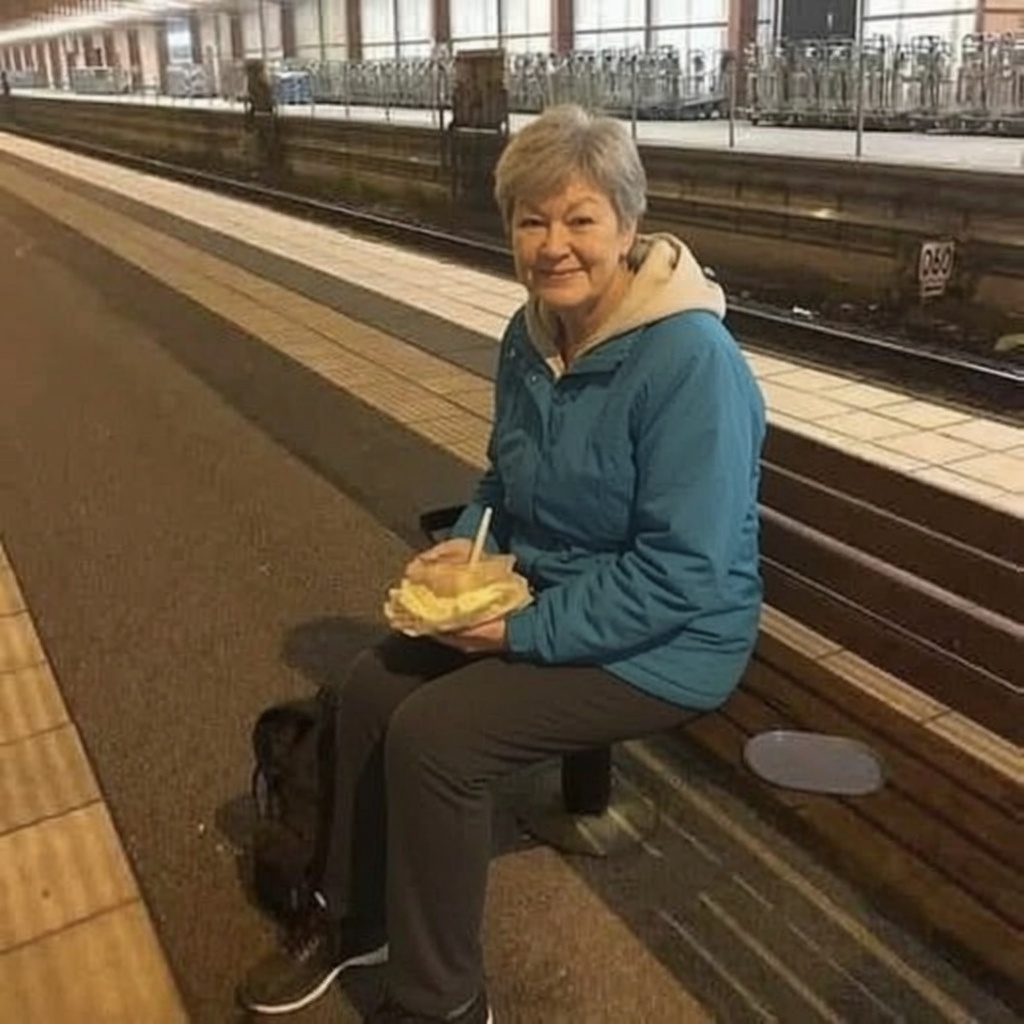
The older woman looked at her kindly, a small crinkle appearing at the corners of her eyes.
“I’m afraid you might have me confused with someone else, dear.”
But the young woman shook her head slowly. Tears were already welling up. Her hands were trembling.
“No,” she whispered. “I’ve looked at your face a thousand times. I keep a printout of it in my wallet. You’re Margaret Ellery.”
The older woman went very still.
For eighteen years, Margaret Ellery had been a name only certain people knew. She had never been on television. She had refused every interview. There was exactly one grainy newspaper photograph of her from 2007, and she had spent nearly two decades quietly living a small life in a small house outside Topeka, tending a vegetable garden and volunteering at a library.
But eighteen years ago, Margaret Ellery had done something almost no one in the country had ever done.
She had been a night-shift nurse at a rural hospital when a young mother was rushed in during a snowstorm, dying of a rare blood condition, giving birth eight weeks early to a tiny, blue baby girl who wasn’t breathing. Three doctors had already called the time of the mother’s death and were preparing to call the baby’s too.
Margaret had refused. She had performed compressions on a newborn the size of her own hand for forty-one minutes. She had breathed into a mouth smaller than a bottle cap. When the on-call physician told her gently that it was over, she had said, quietly and without looking up, “Not yet.”
At minute forty-two, the baby coughed. At minute forty-three, the baby cried.
Margaret had held that baby against her chest for six hours through the storm until a specialist team could arrive by helicopter at dawn. Then she had gone home, made herself tea, and never spoken publicly about it again. She had turned down a medal from the governor. She had turned down a book deal. She had turned down every reporter who called. She had said, every time, the same sentence: “I was just doing my job. Please let that baby have a normal life.”
The young woman on the bench was sobbing now. Openly. Silently.
“My mom died that night,” she said. “I know she did. I’ve read the file. I know what you did for forty-three minutes in a room where everyone else had given up. I’ve been looking for you since I turned eighteen. I hired someone. He couldn’t find you. Nobody could find you.” She laughed through her tears. “And now you’re just… sitting here. Eating a sandwich. In Kansas City.”
Margaret Ellery’s own eyes had filled. She reached out with one gently trembling hand and touched the young woman’s cheek, the way one might touch something precious and long-lost.
“You have your mother’s eyes,” she whispered. “I remember her eyes.”
The young woman — her name was Juno, she managed to say — pulled a folded, wrinkled photograph out of her wallet with shaking fingers. It was the old newspaper clipping. Margaret in her scrubs. Twenty-five years younger. Exhausted. Beautiful.
“I carry you everywhere,” Juno whispered. “You’re the reason I’m here. You’re the reason I finished college. You’re the reason I got married last spring.” She started crying harder. “I’m going to be a mother in November. A little girl.”
Margaret pressed both hands to her mouth. Neither of them cared anymore about the rain or the trains or the strangers who had begun to notice. They just held each other on that wooden bench, one crying into the other’s gray raincoat.
An older man across the aisle quietly took out his phone. He didn’t post the photo for likes. He didn’t share it for a week. When he finally did, with permission, he captioned it with only one line:
“Sometimes the person sitting quietly next to you on a bench is the reason someone else in the world gets to sit next to anyone at all.”
The post went viral overnight. But by then, Margaret Ellery was already back home in her small house outside Topeka, planting late tomatoes in her garden, refusing every single interview request all over again.
Because some people don’t do good so the world will see them.
They do it so the world will have someone left in it to see.
And in November, when a baby girl was born healthy and pink and screaming in a Kansas City hospital, Juno named her Margaret.