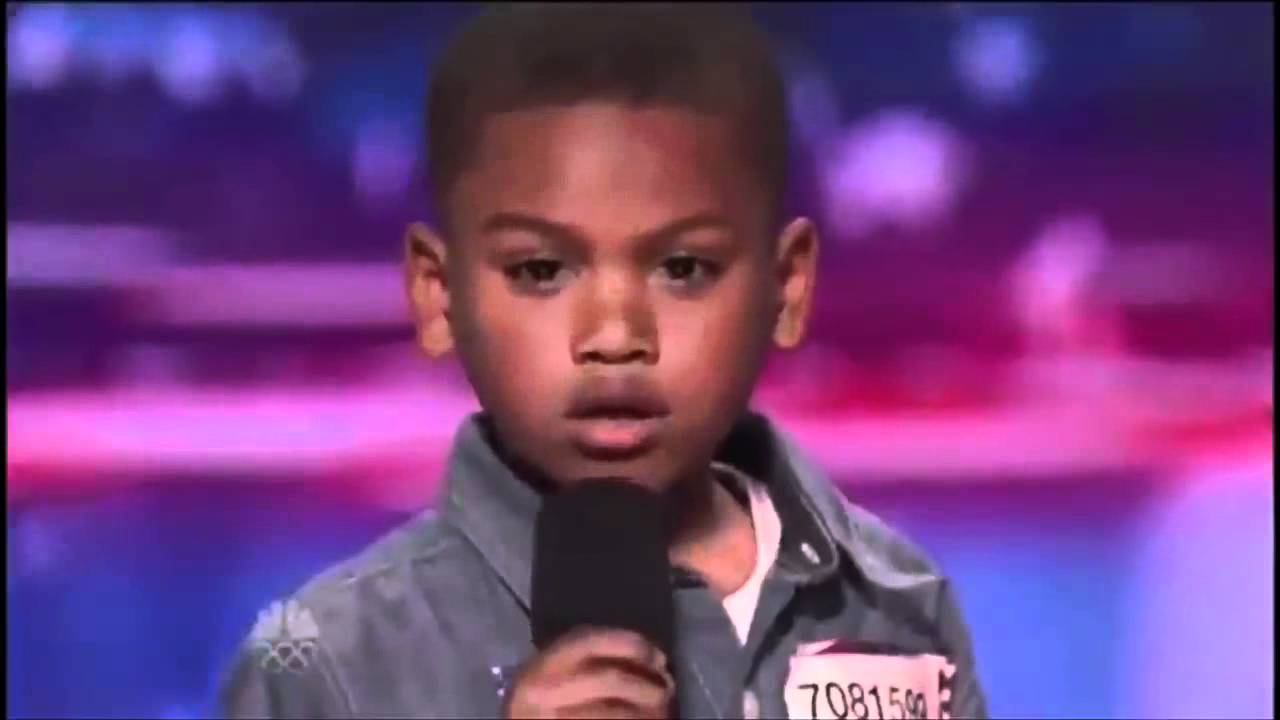
When seven-year-old Mir Money walked onto the America’s Got Talent stage, he carried himself like he owned the place. He was small enough that his feet barely reached the edge of the riser, but he filled the space with an outsized personality: a baseball cap turned backward, a tiny gold chain that caught the stage lights, and a grin that made the audience lean forward. Before he ever launched into a verse, he told the judges — with the kind of blunt honesty kids are good at — that he wanted to win so he could “take care of my family.” The room responded to that line the same way it does to a well-timed joke or a touching confession: you’re warming toward the kid before you even hear him rap.
When the beat dropped, Mir didn’t hesitate. He bounded across the stage with the kinetic energy of someone who’d been practicing moves in front of the mirror, rapping with teeth-bared conviction and a cadence more practiced than his age might suggest. The lyrics were simple but delivered with character: he emphasized the rhythmic quirks, punctuated lines with nods and hand gestures, and owned the pauses like a pro. The audience clapped in time, some people smiling indulgently at the sight of such a small human spitting big-time attitude, others nodding in genuine appreciation for the rhythm and flow he commanded.
Despite the crowd’s warmth, not everyone on the panel was convinced. Talent shows live in a complicated place where judges weigh raw potential against development and sometimes harshly protect younger contestants from the rougher edge of the industry. Midway through Mir’s set, Howard Stern’s red X flashed. A ripple of disbelief moved through the audience; not because a buzzer sounded, but because it felt unexpectedly personal. Howard was followed by another buzzer from a different judge. A few chairs shifted as people exchanged looks that asked, silently: did they really just do that?
What followed is the sequence that made this audition burn into viewers’ memories. Hearing a buzzer is one thing; seeing a child’s brave public composure crumble is another. Mir’s face, which had been all bravado and concentration, softened. The practiced swagger gave way to something raw and immediate: tears filled his eyes, and the rapping slowed into a hiccuping whisper. You could tell he’d been trying to be big for his family’s sake, but the judges’ rejection reverberated in the way kids feel things — fully and without filters. The auditorium’s mood shifted; the laughter and applause evaporated and were replaced by a hush that thrummed with discomfort.
The crowd turned on the judges in a heartbeat. Boos rose up, sudden and loud, cascading through the audience like an uprising. People weren’t booing disagreement about artistic quality; they were booing the sight of a child being hurt publicly. The sound didn’t so much pressure the judges as it underlined the emotional stakes of the moment. Howard Stern, typically wry and blunt, had the kind of change of expression you don’t often see on live TV. His face went from professional detachment to a look of genuine regret.
Rather than let the moment hang, Howard crossed the stage. That slow approach — from stern judge to kneeling adult — was a small gesture with a huge emotional payoff. He bent down to meet Mir at eye level, wrapped the boy in a hug, and spoke in a tone that tempered criticism with comfort. He called Mir “terrific” and “so brave,” not as flattery but as a sincere attempt to repair the rawness his buzzer had caused. Howard even confessed aloud, with surprising vulnerability, “This job is too rough for me… I don’t want to make kids cry.” The admission landed like a soft bridge between the world of televised critique and the human cost of those critiques when they touch the very young.
Mir didn’t advance in the competition, and on paper that could read like a failure. But the aftermath of his audition told a different story. Clips of the performance and the consoling exchange with Howard spread across social media, and people responded with overwhelming affection. Fans praised the little rapper’s courage for stepping in front of millions and for trying to use his talent to help his family. Many commenters noted that the audition highlighted an important conversation about how talent shows handle child performers — balancing the desire to be honest with a duty of care.
There was also a tenderness in the way people talked about Mir afterward. Viewers imagined him back in his neighborhood, replaying the moment for family members who’d come to cheer him on. They pictured the tiny gold chain bouncing as he walked, the way his voice might deepen and grow over the next few years, and the lessons he’d carry from an experience that combined exposure, disappointment, and encouragement in one compressed slice of life. For Howard, the moment seemed to linger too; his unscripted apology and hug underlined that sometimes empathy matters more than critique.
In the end, Mir Money’s audition became one of the most talked-about segments of the season not because he failed to win over the judges but because he embodied something brave and vulnerable: a child willing to stand up and perform for the people he loved. That kind of courage, televised in all its awkward glory, resonated far beyond the stage. Whether he grows into a recording artist or simply keeps making music for family and friends, viewers were left with a clear memory of a moment when compassion won a round against competition — and where a seven-year-old taught millions a lesson about heart.