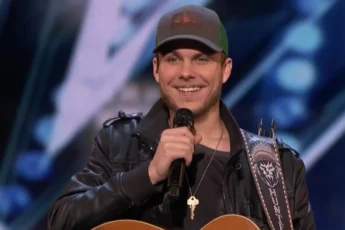
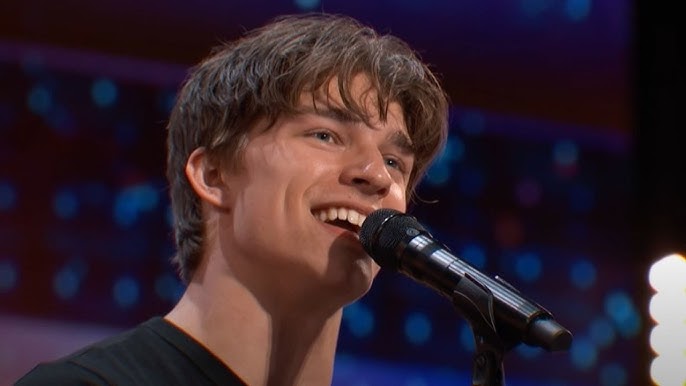
Twenty-year-old Alex Sampson walked onto the America’s Got Talent stage with the sort of nervous energy you can feel from the first step — a mixture of excitement, fear, and the kind of hopeful determination that makes strangers lean forward. He came from Adakoken, Ontario, a tiny town where the biggest public performance venue he’d known was a car wash that, by some lucky quirk of architecture, produced surprisingly good acoustics. That image stuck with him: practicing harmonies while suds hissed and brushes spun, learning to trust his voice in a place no one expected music to come from. Standing now beneath bright studio lights and a sea of faces, he admitted to the judges he was scared he might forget the words, but his candidness only made him more endearing. It was obvious he wasn’t there to fake confidence—he was there because he had to try.
When Alex began singing “Pretty Baby,” an original he wrote himself, the room seemed to tilt gently backward in time. The arrangement and his phrasing carried a warmth and restraint that felt like walking into a record store and pulling a vinyl with rounded corners out of a stack. His voice had a retro grain to it, not an imitation but an heirloom quality, the kind that made you picture classic diners, neon signs buzzing, and couples slow-dancing under a jukebox glow. Lines about lipstick smudged on a cheek and nights spent staring up at the stars were small details that, in Alex’s hands, didn’t feel cliché; they felt lovingly chosen, like the final brushstrokes on a painting meant to look lived-in and familiar.
There was a quiet confidence to his stage presence that belied the tremor he admitted to feeling. He didn’t need to shout or theatrically belt to be compelling — he let the melody breathe, and in the space between notes, you could hear his storytelling. He used subtle dynamics, a slight catch on a phrase here, a breathy softness on an intimate line there, and it all made the performance feel personal, as if he were singing to someone across a kitchen table rather than a packed auditorium and millions of TV viewers. The contrast between his small-town beginnings and the polished stage was part of the magic: someone who had honed his craft in unlikely places now placing a timeless-sounding song before a modern audience.
The judges’ reactions reflected how rare it is to hear something both familiar and fresh. Sofía Vergara praised his presence, noting that he had the kind of stage charisma that makes an audition memorable. Howie Mandel’s comment that “nobody’s doing that now” wasn’t meant as a dig but as recognition — in a landscape saturated with hyper-produced pop and autotune, Alex’s choice to lean into a retro aesthetic felt smart and strategic. It wasn’t nostalgia for its own sake; it was a deliberate decision to carve out a niche. Simon Cowell went as far as saying the song could fit into a Martin Scorsese movie, a compliment saying as much about cinematic authenticity as it did about songwriting. He called Alex’s authenticity “very different,” a rare and valuable trait in a business that often tries to replicate what’s currently trending.
These responses highlight a larger point: originality can look backward as much as forward. By reaching into the past for inspiration and combining it with modern songwriting craft, Alex managed to create something that transcended eras. “Pretty Baby” has the structure and lyrical economy of a classic pop standard but avoids sounding like a pastiche. The production choices — restrained instrumentation, warm microphone tones, and just enough reverb to hint at nostalgia — supported the performance without overshadowing his voice. It was the sort of song where a single well-placed harmonica or a gentle brush on the snare would have felt right; thankfully, Alex and his team didn’t over-embellish. The result was a focused, stylistically coherent piece that let the melody and story carry the weight.
There was also an emotional honesty that made the judges’ praise feel earned. Alex’s nervous jokes and his admission about the car wash rehearsals framed him as someone who hadn’t arrived at a persona crafted for television; he’d arrived with a life and a history that informed his art. That authenticity resonated. You could imagine listeners hearing “Pretty Baby” on a late-night radio show and being pulled in by its simplicity — a reminder that songs don’t always need to scream to be heard. By staying true to himself, Alex turned vulnerability into a strength.
When the verdict came and he earned four yeses, it felt less like a surprise and more like the natural next chapter in a story that started in a place with no stage and ended with a song that sounded like it had always existed. For Alex Sampson, the leap from a small-town car wash to a national stage wasn’t just about visibility; it was proof that thoughtful songwriting and a distinct artistic identity can still cut through the noise. If his audition was any indication, he’s not just reviving a vibe from the ’50s — he’s translating it for the 21st century in a way that’s both respectful of its roots and undeniably his own.